It's been a bit since my last post, so let me catch you up. In 2009 when Todd left the Air Force and we decided to move home to San Diego we were starting from scratch. We rented a few different places, and once both of us had stable jobs we decided to buy a home. We bought what we considered a starter home, it was small had lots of work to be done and was definitely not in the best neighborhood, or school district (mind you it could have been much worse), but it wasn't a place we wanted to stay forever. Fast forward 4 years and about a ton of elbow grease later, Todd and I decided that it was time to move, our house's value had risen enough that we would be able to get something nicer, but not too much, meaning it still looked like a great deal. So now we are caught up to present. We've bought a home on the outskirts of San Diego, in Ramona. Ramona is a beautiful city, not quite rural but definitely not like it is in the city. The air is fresh, the views are stunning, and the properties are big. Our place is about an acre and a half, which is a lot, and as you can imagine I'm itching to make it my own. We're lucky in that it is a blank slate, with no real water hungry landscaping, but unlucky in that there are no mature fruit trees (just dozens of eucalyptus). After moving up here my brother in law lent me his copy of "Gaia's Garden-A Guide to Home Scale Permacultre" by Toby Hemenway. I must say that this book has changed my view of gardening and has really inspired me, which wouldn't matter except I've got that big piece of land staring at me daring me to go on and do something (much to Todd's dismay). Which brings me to today, Todd is away in Portland. I'm sure he's having a grand ol' time as he's with my soon to be brother in law for his bachelor party, but it also leaves me here, at home, with no one telling me not to start a new project. I've been telling him for a few weeks now that I want to build a Hugelculture, which is just a strange Germanic word for raised bed garden that is filled with logs and sticks. Todd's been going crazy with me talking about it non-stop, so today, with him away, I pulled out my tools and decided to go ahead and make one. The supposed benefit of using a Hugelculture has to do with the ability of dead wood to absorb water, a well watered hugel retains moisture and so doesn't need to be watered as often, not to mention that the organic matter inside the hugel breaks down over years and feeds the plants planted in it and also replenishes the dirt around it. Another great feature is that on our gently sloped yard it creates a swale, which when, or if, it rains it will create a barrier slowing runoff and increasing the ability of the rain water to be absorbed into the ground. It is obvious that our yard allows water to drain a bit too freely during a rain storm, something I intend to remedy.
So the first step was finding a good location for my hugel, it needed to be on a slope, within reach of a hose, and also not too centrally located (as this was a semi covert operation and I don't need to cause unnecessary trouble with the hubby). I settled on a spot next to the driveway with a good amount of slope where lots of runoff can be collected, and where a hose will reach until California sees some rain.
Even though the slope was already there, I had to clear it more to create a flat spot to pile up all my logs and branches, I wanted to make the hugel start at the bottom of the slope but be about as tall as the existing hill, needless to say it was a lot of digging in very hard dirt, but hey it doubles as a workout, and I love multitasking.
One small problem was the amount of weed debris I created when clearing the spot, out place had been empty for a good while before we moved in and the amount of uncut brush, and invasive thistle is pretty daunting. I decided to use the little knowledge of composting and the even larger amount of ignorance I have to "hide" all that awful weed seed infested organic matter in my hugel bed, a compost heap can kill the weed seeds due to the heat created by decomposing matter, so I took the easy way out and just filled the bottom of my ditch with the pile of weeds (Yes, this will most likely come back and haunt me, but it can't be worse that it was).
I did however, create a barrier between the weeds themselves and my hugel insides, just to be on the safe side, cardboard is a great tool for smothering unwanted plants, so I used it as the base of my hugel and began piling.
The next step involved scavenging my yard for stumps, logs, and branches that were hiding under bushes and in thecreek bed. It didn't take long, I have enough dead wood lying around for another 3-5 hugels, easy. One problem is making sure that I don't use too much eucalyptus, as a hugel made of all eucalyptus could be bad for the garden, it has allelopathic properties, which just means it's toxic and can stunt other plants from growing around it, did I mention how many eucalyptus trees are on our property? It's obscene, no wonder it's just a wide open dirt patch. Fortunately we have a variety of trees in varying stages of breaking down all over the yard.
Now is where the dirty work begins. Did I mention that there used to be horses on our property? Probably not, it's really neither here nor there, except that we have a surplus of manure all along our fence line, just waiting to be put to better use.
Between all the horse manure, and the mess that our chicken flock creates, I was able to cover the entire hugel in a nitrogen rich layer of, well, dung. This will help keep the mound more balanced and able to support plants more readily, it was however not the most pleasant portion of the entire hugel experience. At least it was all free, I'm sure slopping paid for poop is more upsetting that slopping free poop, but only just.
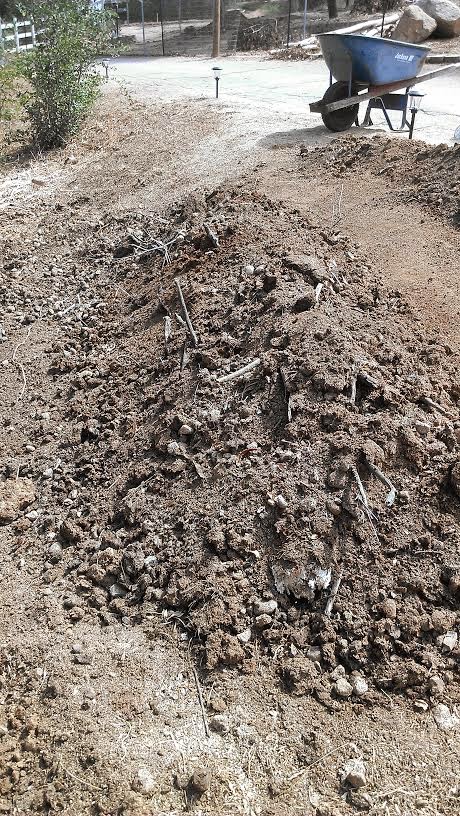
At this point I got the pile nice and wet to make sure the inside of the hugel wasn't starting out dry, the wetter it is in the beginning the less I'll have to water it over time. I also wanted to make sure that the pile would stay put, even if it got wet, I don't want all my hard work washing away at the first rain. After a good soaking I simply pushed the original dirt back over the hugel. This is where, if Todd were home he'd intervene. Luckily he isn't here so we didn't have to go off to the nursery and buy garden soil. I like to use the free dirt that came with the house (are you starting to see my cheap streak)? Sure garden soil might look better, so dark and loamy, but we're creating healthy soil from the bottom up. If this comes back to haunt me, so be it; at least I didn't waste any money in the mean time.
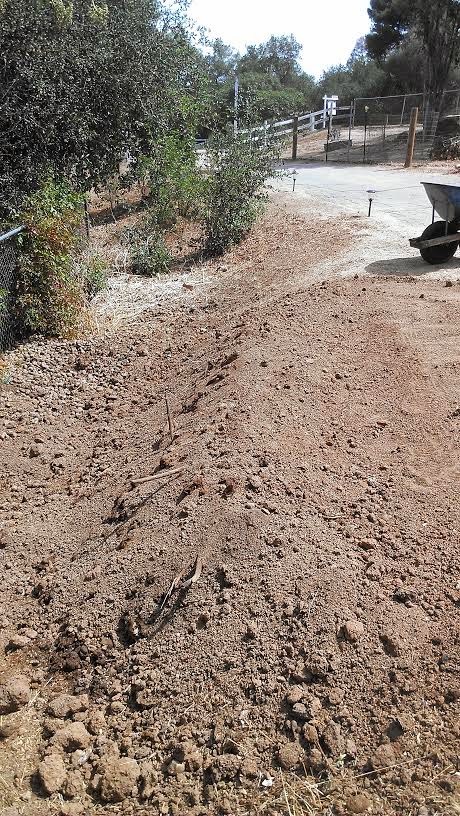
So what did I get out of this project? I mean so far it looks like all I did was dig a big trench in a hillside, just to put all the dirt back to once again have a hillside, oh yeah did I mention how much poop I had to shovel? Well, for one, I got the satisfaction of knowing that I'm starting the process of making my property more water wise, once we do get rain I'll be storing a little bit of it right there in that mound and the plants I plant there will be lush and green without me having to turn on the hose. I'm also building better soil, which will benefit us for years. But best of all I was able to make my property produce, there is nothing better than sweating over a piece of land and being able to reap, literally a harvest from your hard work. Very soon my hugel will be providing us with kale, chard, arugula, rosemary, chives, carrots, beets, garlic, green beans, and strawberries (sounds like a lot right, but that mound is huge 4ftx8ft and 3 dimensional).
All this before noon, I think it's time to relax.
Restaurant reviews, litarature reviews, recipes, general thoughts and musings from day to day.
Friday, July 18, 2014
Tuesday, March 26, 2013
10 Tiny Minutes
Judy Reeves author of "A Writer's Book of Days" was the presenter. Her message was essentially if you are a writer, then write! Easier said than done, right? But then she went on to simplify it even more. You don't have to write to be published, you don't have to write to be read, if you're a writer you need to write simply to write. That inner expression is what makes a writer happy, and if no one ever reads it, you've satisfied your creative urge just by doing the practice. I've thought this so often; I need to just make myself sit down and write, but the computer is my foe. I'll be distracted by Facebook, or who knows what else. Judy's answer to this, don't use a computer. The art of writing is so much more that just selecting the next word, you should "write with your whole body", hand to paper thought flowing and just let it happen. When we first sat down she asked us to write down a concrete fact that we had noticed that morning something that grabbed our senses. My fact was "The ceanothus outside Peet's was extra indigo this morning." This is something that only I would notice, I'm especially obsessive about these beautiful plants. After a bit Judy asked us to take the tips that she had given to us and use our sentence as a jumping off point, to put pen to paper and just write, this is what the next 7 minutes became:
The color of San Diego is blue. Blue clean crisp skies; deep blue oceans, rarely marred by a graying day, but more than anything, the blue of a ceanothus. Bright blue against a green sagebrush canvas. Each as individual as a snowflake. Some barely leaving the world of gray-scale. Some, robins egg, touching its closest neighbor a deep cerulean blue. Their honeyed fragrance reaching out to the birds and the bees, it is spring after all, finding its way above the salty sea air, the earthy sage and musky sumac. These are the smells that have transgressed ages, same for those first men and women grinding acorns on granite boulders. But most amazing of all, the most striking, is that deep indigo cone on the rarest California Lilac.
That was the end of the 7 minutes, I really wish there had been more time, I was just beginning to get immersed in it when the timer went off. So this is my goal to myself, my new "Tiny Habit", I will find 10 minutes a day to write, just for myself, anything, with no story or framework in mind, just for the satisfaction it gives me. I hope that it will grow into something more, but if it doesn't at least I'll have that 10 minutes each day.

Monday, February 4, 2013
On the Road with Steinbeck
I started a new book today. If I'm being totally honest, I started a new audio book. Todd got me hooked on Amazon's Audible.com, it has effectively tripled my reading time. It's a strange thing, being happy traffic is adding time to my commute; it means I can get in another chapter. Today I began "Travels with Charley" by John Steinbeck. Of all the books I've listened to so far this is the first one I've been a little sad I'm not reading in the old fashioned way. There is something about the way the prose sounds; I know it would make me happy to see the words play together and jump off the page. When I selected this book, I actually was selecting a book Todd had placed on his wish list. I'd read some Steinbeck before, obviously the "Grapes of Wrath" is one of the most necessary books for any American to read. Images from that book still stick with me today, I have a feeling that this book is going to be the same. Since I don't know anything about this book, other that what I've listened to this morning, I'm going to take the plot at face value. I'm going to fight my urge to Google the locations that he's visiting and the name of his truck. Because even if it isn't autobiographical I want to believe it is. He sets out on a cross country journey, just to prove that he isn't stagnant, that he has life in him and he isn't going to just lay down and let himself get comfortable. He talks about wanting to live fiercely rather than gain a little extra yardage (such an adept image the day after the Superbowl). He's writing in a time where America is on the cusp of something. Like I said, I refuse to Google, so I'm going to piece together the bits that I can. America is in the middle of the Cold war, he sees submarines that are carrying "mass death", and Khrushchev is visiting the United Nations. He's mad that America is letting Russia to take the lead. It's an election year and he isn't revealing who's running, just that everyone is very secretive and there isn't much debate, as though there hasn't been enough time to digest the changes the world had seen in the past decade, that man needed to mull it over a bit longer before they could make up their mind. He's contemplative about the effect manufacturing must be having on the Earth, that everything we make comes in boxes and packaging, that the bulk of that is more than everything we use combined. he wonders out loud if we'll reach a point where we can't keep burying ourselves in the trash of it all, polluting our rivers, and burying the radioactive waste we create underground. Steinbeck is ahead of his time, seeing the wastefulness of modern life. He's only been on the road for a couple days. I can't wait to see where Rocinante, his truck, takes him next.
Monday, December 17, 2012
In the Wake of Loss
A few years ago a person very close to my family passed, much too early. I wrote a poem after the service. It was the only way for me to deal with and express the feelings I was having.
On Friday I began to think how that poem, though written for a different person, and completely different situation, expresses again the feelings that I'm struggling with. I'm sure it is because my oldest daughter was born the same year as most of the young children that were slain at Sandy Hook elementary school. All weekend I looked at her and thought of the beautiful person that she is becoming and saw the light in her eyes and couldn't bear to think of the anguish it would cause me. I'm making the best out of this for myself. Each day I will strive to treat her in a way that if it was the last there would be no regrets; I know it should be that way already, but in the face of frustration I'm not always perfect. I've spent too much time already mulling over this weekends discoveries, making it too much a part of my thoughts. I need to try and move past thinking about it, and I'm so thankful that I have that ability, that this isn't going to be something I have to carry with me everyday for the rest of my life. But there are so many families this week without that choice. This poem reflects the pain that we see them carrying, and that as outsiders we can only understand a fraction of that.
The hollow thud; shattering.
Empty, I toss my load aside.
Aching with the finality,
crushed under it.
Unsure; I go.
Alone.
A memory.
That echo
Friday, November 9, 2012
A Thousand Splendid Suns
I wrote this a few years ago when 'A Thousand Splendid Suns' first came out. If you haven't read his second novel yet you MUST.
Khaled Hosseini, author of 'The Kite Runner', has written a second amazing novel. It may seem unimaginable that this book could be as strong as 'The Kite Runner,' but be ready to be surprised; this novel is so beautiful and perfectly told. 'A Thousand Splendid Suns' may even outshine her famous older brother.
'A Thousand Splendid Suns' is set in Afghanistan and tells the country's tale of devastation through war, and the compelling survival of its people through not just one invasion, but three. The story opens with an Afghanistan full of culture and a sense of self a country that appears to have a balance of old and new, culture and religion. This all changes when Russia invades. The people of Afghanistan are forced to relearn their way of life literally overnight. These changes don't all appear negatively; women are encouraged to be equal to their male counterparts and are allowed to go to school, and to hold jobs in all fields. Then the Taliban overthrow their occupiers, it's a story that we all think we know, but can't on an intimate level. All the liberties and freedoms that were known under the Russian occupiers are stripped away, and everyone is fearful for their lives. One misstep, one look astray and you may disappear. None are more affected than the women of Afghanistan who must give up their veils for one ruler, then are forced to cover their entire body by another, un-allowed to leave the house alone, or even receive medical treatment. It is here, with the women of Afghanistan that this story shines.
Two women, born a generation apart, who have known two entirely different Afghanistans, one a girl raised in the rural country-side by her mother during a time of relative peace and freedom. The other, born in Kabul on the night of the Communist invasion, knowing nothing but a life filled with war. These two unlikely companions are brought together by the appalling circumstances of war; they must face the loss of freedom, the trials of war, an arduous husband, and the regulations of the Taliban together.
In a life where one must learn to mould oneself to society's changing standards, and be subservient to the very people who have usurped your life, we learn that in exchange for love, no price is too high. We also find that real family and personal identity can be very fluid ideas. But above all that some things are too precious to lose. This is an astonishing tale of love and the survival of Afghanistan itself, mirrored beautifully and tragically in the lives of its women. Hosseini alone can weave a sympathetic and heroic tale of injustice in such a masterful way. This is a great story, from the storyteller who has opened the hearts of the west to the suffering of Afghanistan.
Monday, October 29, 2012
Snuff said.
The next look back is of a book that many probably won't have heard of. It's author, Chuck Palahniuk, is more famous for his novel, turned cult movie favorite, "Fight Club", but his CV is full of many strange and dark novels.
Chuck Palahniuk's newest novel 'Snuff' is firmly located in the grotesque, defined in the OED as (1) comically or repulsively distorted (2) incongruous; absurd. Palahniuk alone is capable of setting a story around a world record breaking gangbang, and keeping the tone only mildly sexual, focusing instead on the dark humor of the situation at hand. 'Snuff' is narrated by four characters participating in the sex film aimed at being the last, and most spectacular record setting sex act ever. In Palahniuk's other books the characters are all fully fleshed and believable, each one having some mental or emotional instability which allows the reader to connect with them. In 'Snuff' the characters seem to be very shallowly created, to the point of Pastiche.
Mr. 600-Branch Bacardi-is the stereotypical ancient male porn actor; he is hoping to resurrect his career with this film. He judges everyone by their tan, Acapulco vs. San Diego, and is surrounded by TVs showing him and Cassie (the star of the show) in many of their previous films; including Blow Jobs of Madison County, The Da Vinci Load, and To Drill a Mocking Bird. He is the leather skinned, loose waisted, wrinkle covered version of the handsome man on screen, so changed he doesn't even recognize himself. Mr. 137, the washed up TV star whose show has been cancelled because of rumors of homosexuality. He figures if he's seen in heterosexual porn his reputation will be cleared. From him we learn all about Cassie's movie career, and learn that he is obsessed with her in a purely aesthetic way. His real desire is hidden away in his closet along with the life like dildo molded from the perfectly proportioned Branch Bacardi erection. Mr.72, the youngest participant we meet is hoping to lose his virginity to Cassie, we think. To him she's the perfect woman, and we begin to see oedipal tendencies that would put even Freud on edge. Finally there is Sheila, the only female narrator. She is Cassie's assistant and allows us our only insight Cassie's state of mind. Sheila finds men ridiculous in general; this is most obvious by her continual reference to men with hilarious euphemisms for masturbation, Hoagie Honker being my all time favorite. She is the brains behind the whole operation, yet continually ridicules it at the same time. Don't be fooled by her seemingly innocent appearance, she has a dark secret driving her actions, just like every other character we meet.
The dark humor that Palahniuk is so known for is rampant in this novel, but without the intensely real characters to bolster the plot it simply doesn't compare to his earlier work. Although I must admit it is worth reading simply to find all of the hilarious ways Palahniuk comes up with for saying, well, Palm Pilots or Bacon Banger, these are laugh out loud funny even if the novel itself falls short.
Thursday, October 25, 2012
A look back on past work
Life has been busy, and I've been negligent. I've been wanting to create something new and fun for this spot, but haven't been able to find the time. This month, in light of my packed schedule, I'm going to post some older pieces, book reviews that I wrote a couple years ago. The books may not be new, but the great thing about print is it's timelessness. So, with no further ado, today's look back in time is my review of Knockemstiff, a collection of short stories:
Welcome to Knockemstiff, Ohio, the unhallowed playground of Donald Ray Pollock's imagination. This group of short stories is different than most, as the stories are all interconnected creating an almost novelesque story line. Each story is located in Knockemstiff, and is narrated by a different resident, except the first and the last; these are both narrated by Bobby. Doing this provides a frame to the intriguing collage Pollock creates with his snapshot like stories. In the first story we see Bobby as a young boy; he's at the drive in with his mom and dad. His mom forgets dad's favorite cup and he refuses to drink out of the bottle, like an alcoholic, so he drinks out of the ashtray instead. We begin to see that this type of thing is pretty common, and that both Bobby and his mom become more leery the more dad drinks. Bobby and his father share a rare bonding moment, what appears to be their first and last, when they get into a fight with another father and son, and Bobby is praised for whopping the other boy. Bobby is never able to regain that connection with his father, which becomes apparent in the last story. Here Bobby is a grown man, trying to fulfill his AA obligations, but can't seem to come clean where his family is concerned. His dad, although he's lost his physical prowess, still manages to browbeat his family into submission. Of all the stories in this collection this is the most optimistic.
Knockemstiff, named after a fight between two women over a man, is a place where money has no value, sex and drugs are the only currency worth anything, and a useful inheritance is a prescription. The cycle of abuse is so strong here that it is virtually unavoidable. The characters all have a unique voice and each one reveals a different, depraved aspect of Knockemstiff. Characters meander in and out of each other's stories, allowing us a more complete picture of each other than is provided by the characters themselves. What is clear is that nothing good can come out of Knockemstiff, Ohio; nothing that is except Donald Ray Pollock and this spectacularly bleak set of stories. You'll love to read this book, the writing is superb, and even learn to love Knockemstiff-which is a real city-despite, or maybe because of its self destructive nature.
Subscribe to:
Posts (Atom)


